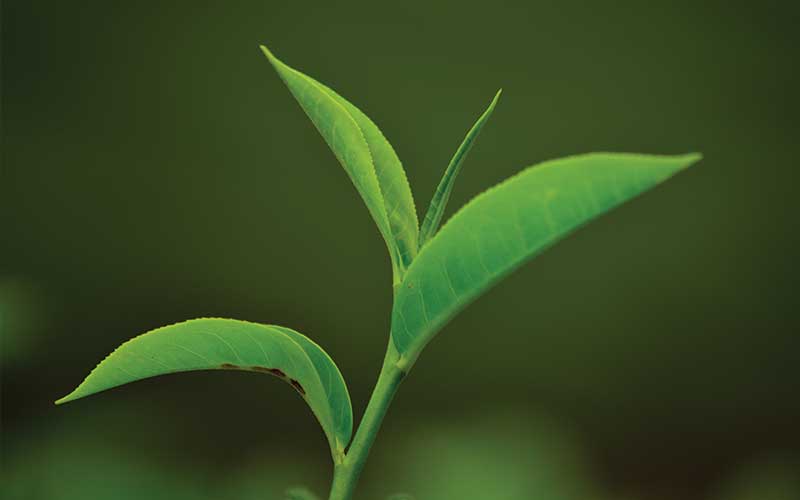
All true tea comes from just one plant – the Chinese Camellia or Camellia sinensis. It is reputed that the first tea plants were found in what is now the Yunnan Province of China nearly 5000 years ago. Most of the tea grown in the world today can be traced back to these first wild tea plants, although a strong case can be made that the Camellia sinensis var. Assamica is native to the Brahmaputra River valley in Northeastern India.
The tea plant is a broadleaf variety of evergreen shrub, which is commonly pruned to form a bush 3–4 feet in height in commercial tea plantations. Should workers not prune the bushes, the plants would naturally grow to a height of 9’–60′, depending on the variety.
The oblong leaf is typically green in color, with a serrated margin and a glossy appearance.
The primary determinate for the type of tea that will be made out of a particular leaf will be the manner in which that leaf is processed once it is picked. The level of oxidization is especially crucial in determining whether the leaf will become a black, oolong, green, yellow, or white tea. With this being said, it is also very important to note that tea is certainly an expression of its environment as well. Much of the intrinsic aroma and taste within the leaf will owe directly to its terroir, to borrow a term from the wine industry. Terroir will include such things as the soil in which the plant was grown, the site’s specific microclimate, its elevation and latitude, the characteristics of the growing season, even the timing of the plucking of the leaf – down to the very hour of the day that the tender branch tips were picked from the bush. This interface between the tea plant and its environment has led to several hundred different varieties of the Camillia sinensis plant within the boundaries of China alone. Through this combination of processing techniques and varieties of tea plant, the world’s tea producers are able to create over 10,000 distinctly different tea varieties for the enjoyment of tea enthusiasts everywhere.